Landscaping contractors
Prepare beds, trees, shrubs and lawns with a soil amendment supported by application guidance for your site.
 العربية
Products
Supporting growth in desert soils.
Green Compost developed to support plant growth and water retention in arid conditions. For agricultural, landscape and garden projects, discuss soil and planting requirements with our team.
Get a quotation01
The product
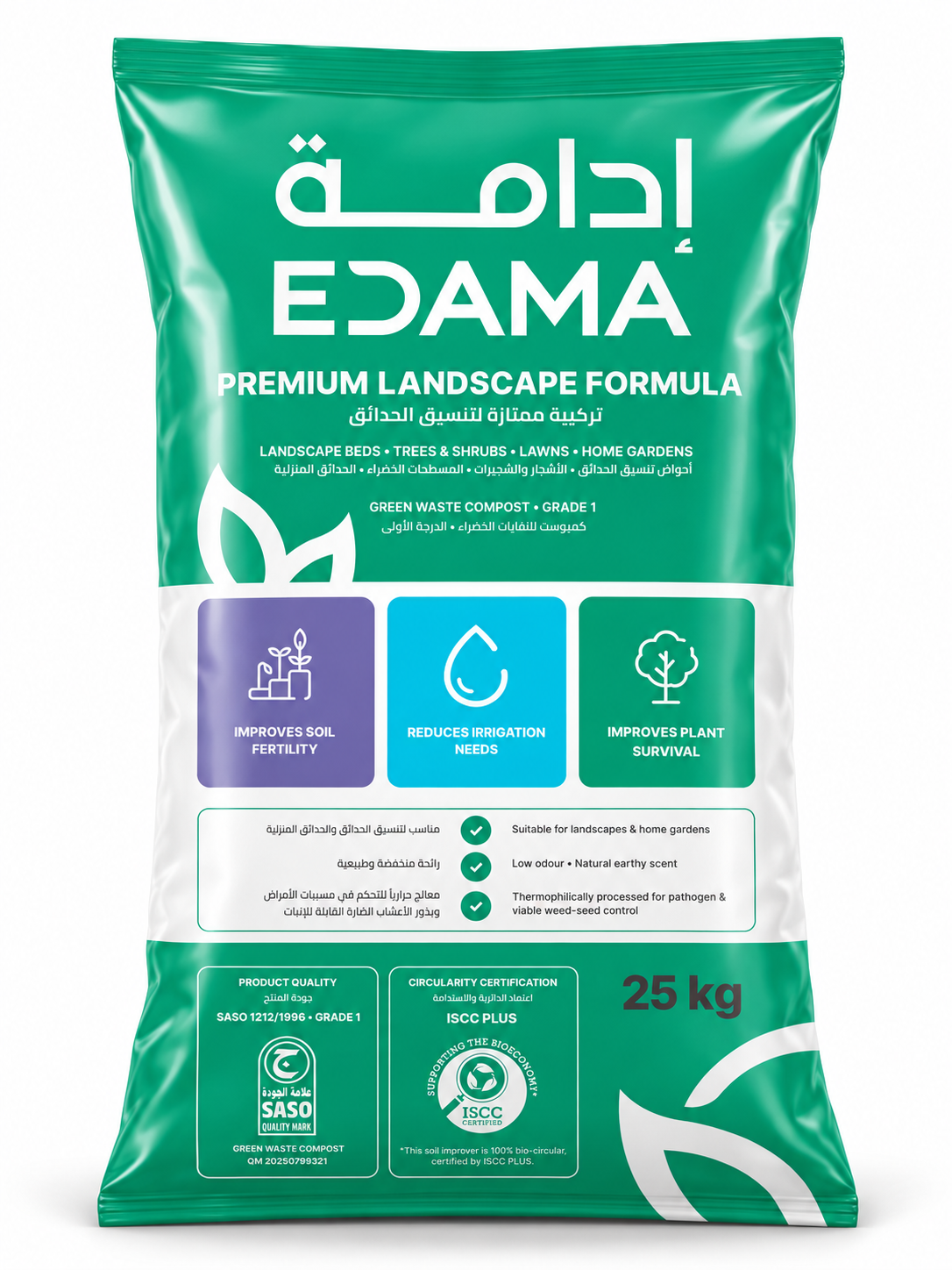
Made by composting landscaping green waste, including palm fronds, leaf litter and grass clippings, with a minor component of food residues.
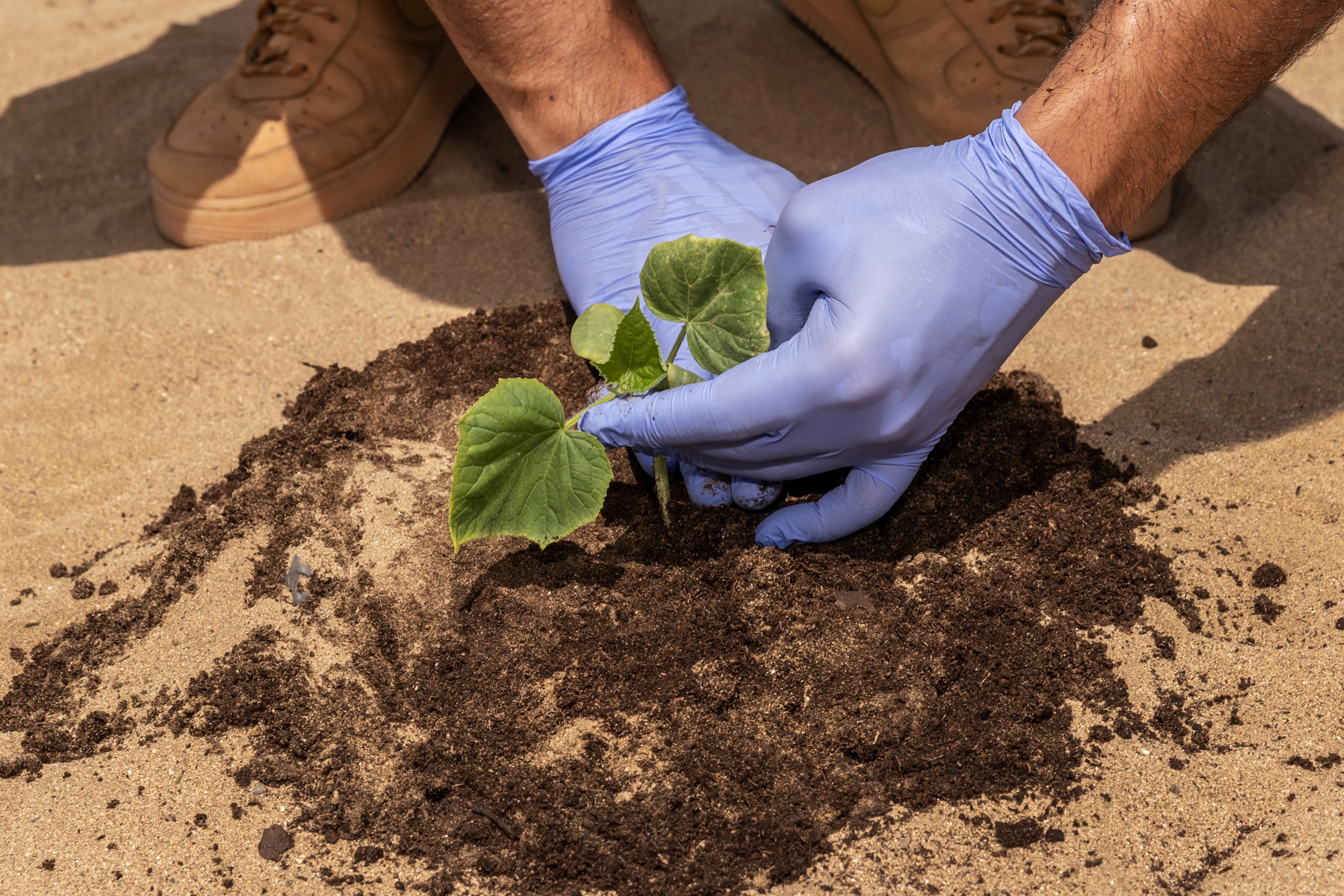
Blend with existing soil for landscape beds, trees and shrubs, lawns and home gardens. Match the application rate to your soil and planting needs.
Application rate calculator
Select the intended use and enter your project dimensions. The calculator applies the recommendations printed on Edama's current 25 kg bag.
Mix 20–30% by volume with existing soil or agricultural sand.
Who it is for
Prepare beds, trees, shrubs and lawns with a soil amendment supported by application guidance for your site.
Assess soil specifications and proposed substitutions using technical data, trial conditions and quality evidence.
Bring circular materials into your landscape and document their use for sustainability reviews.
Explore sustainability evidenceBuild a consistent soil-blending routine for established plants, with guidance matched to your growing conditions.
Product benefits · Trial evidence
Controlled trials show how Premium Green Compost supports plant growth and water performance when blended with soil.
Plant growth
Sea Purslane produced 43% more fresh biomass with Edama than with a peat moss and manure blend in a controlled greenhouse trial.
Measured means · PRJ-024B · Figure 2
PRJ-024B · Sea Purslane · 25% by volume · greenhouse · Oct 2024–May 2025 · n=8–10 per treatment
Irrigation efficiency
Edama required 30% less irrigation for each unit of plant biomass produced than the peat moss and manure blend in the same trial.
Measured means · PRJ-024B · Figure 4
PRJ-024B · Sea Purslane · 25% by volume · greenhouse · Oct 2024–May 2025 · n=8–10 per treatment
Water retention
Edama-amended sandy soil held 26.0% water by dry mass at a 10% amendment rate by volume in the laboratory trial.
Measured means · PRJ-003 · Figure 1
PRJ-003 · sandy soil · 10% by volume · laboratory · Mar 2023 · n=5 per treatment
Storage & performance stability
After two months between soil application and planting, the Edama treatment retained 93% of its plant-growth performance, compared with 69% for peat moss plus manure.
24 percentage points more performance retained in this trial. The result concerns aged soil blends before planting; it does not establish unopened-bag shelf life.
Average fresh plant biomass, relative to each treatment's fresh-substrate result (100%).
PRJ-024B · Sea Purslane · greenhouse · 25% by volume · Oct 2024–May 2025 · n=8–10 per treatment
Source: Edama Technical Memo, February 2026 · Case Study 2, Figure 3.
These are measured trial results. Performance depends on the species, soil, application rate and irrigation conditions.
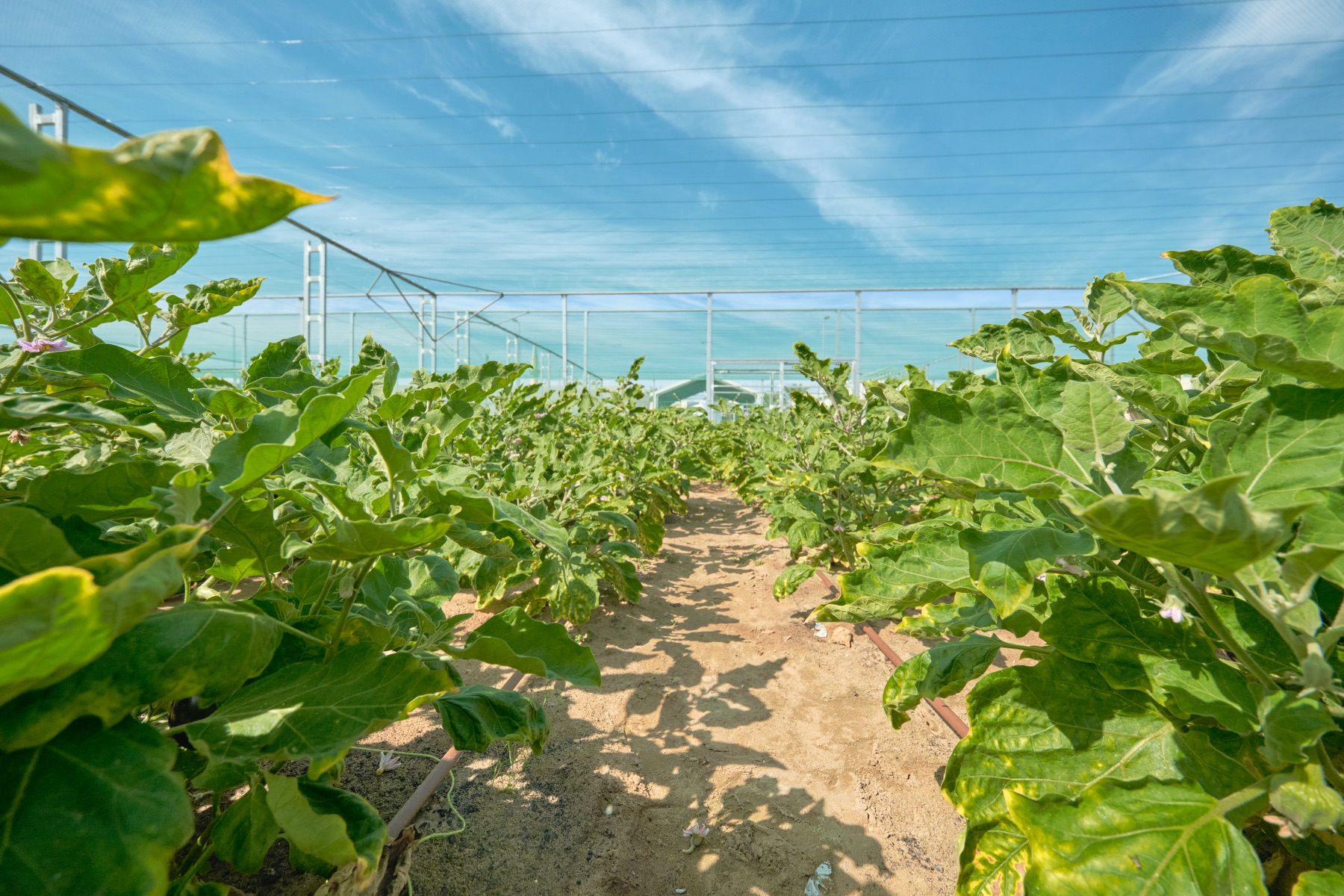
Sea Purslane (Sesuvium portulacastrum) was grown in 3.5 L pots in a greenhouse with evaporative cooling, October 2024–May 2025. Both treatments used 25% amendment by volume, with 8–10 replicates per treatment.
Average fresh biomass was 150.7 g with Edama and 105.7 g with peat moss plus manure. Irrigation per 100 g of biomass was 7.2 L and 10.2 L respectively. The irrigation result measures water use relative to plant biomass, rather than a reduction in a landscape's watering schedule.
The March 2023 laboratory comparison used soil containing 93.1% sand, 6.4% silt and 0.5% clay. Edama and peat moss were each mixed at 10% by volume, with five replicates per treatment.
Mean ± standard deviation was 26.0 ± 0.4% for Edama and 27.1 ± 0.9% for peat moss, recalculated from the five replicates in the original data. WHC is water mass relative to dry substrate mass. Overlapping SD intervals describe variability; they do not establish statistical equivalence.
Source: Edama Technical Memo, February 2026 · Case Studies 1 and 2 · Figures 1–4.
Certifications & sustainability
Evidence for the material you specify and the sustainability goals your project pursues.

Product quality
SASO 1212/1996 · Grade 1
Premium Green Compost is classified as Green Waste Compost, Grade 1 under the SASO Quality Mark licence.

Circularity certification
Bio-circular · Mass Balance
As stated on the packaging*“This soil improver is 100% bio-circular, certified by ISCC PLUS.”
Edama's certified scope is a treatment plant for waste and residues, with Mass Balance chain of custody.
Certificate holder: Organic Solutions for Environmental Services, operating as Edama. The ISCC mark's asterisk refers to the packaging declaration above.
For project owners & sustainability teams
Choose a local, circular material for your project. Combine landscape performance with evidence your team can use in certification reviews and sustainability reporting.
View available product evidenceLEED project support
Edama can help your project team assess where Premium Green Compost may support relevant LEED requirements, including soil restoration and circular material use, and provide appropriate product and technical information for the review.
Eligibility and points depend on the project's rating system, design, documentation and assessment. Edama and Premium Green Compost are not LEED certified; LEED certification applies to projects.
Return green waste to landscape use. Product, quantity and application records can help document this action within your organisation's sustainability and ESG reporting, supported by the relevant certification and technical information.
Specifications and technical information
Product data, safety information, trial evidence and batch records for your material approval or sustainability review.
Controlled heat treatment helps reduce pathogen and viable weed-seed risks. Premium Green Compost is low odour, with a natural earthy scent. Batch temperature histories and relevant laboratory results support your quality review.
Product identity, intended uses and technical information.
Current handling and safety information.
Laboratory and trial results, including microbiological tests, with the sample, date, method and conditions stated.
The time and temperature history for your batch, available on request to review heat-treatment exposure against the process criteria. Include your batch or delivery reference.
Product questions
Start with the application calculator and select your intended use. It follows the rates printed on the current bag. Confirm the final rate with Edama for your soil, planting design, irrigation and installation method.
Store it in a shaded, dry area and avoid waterlogging or compression. Follow the product’s handling guidance.
There is no universal or one-to-one substitution rate. The trial comparisons apply to the stated application, rate and growing conditions. Ask us to review your soil blend and intended use.
Next
Tell us your project location, intended use, estimated quantity and delivery timing. Include any application questions or documents you need in the same enquiry.