
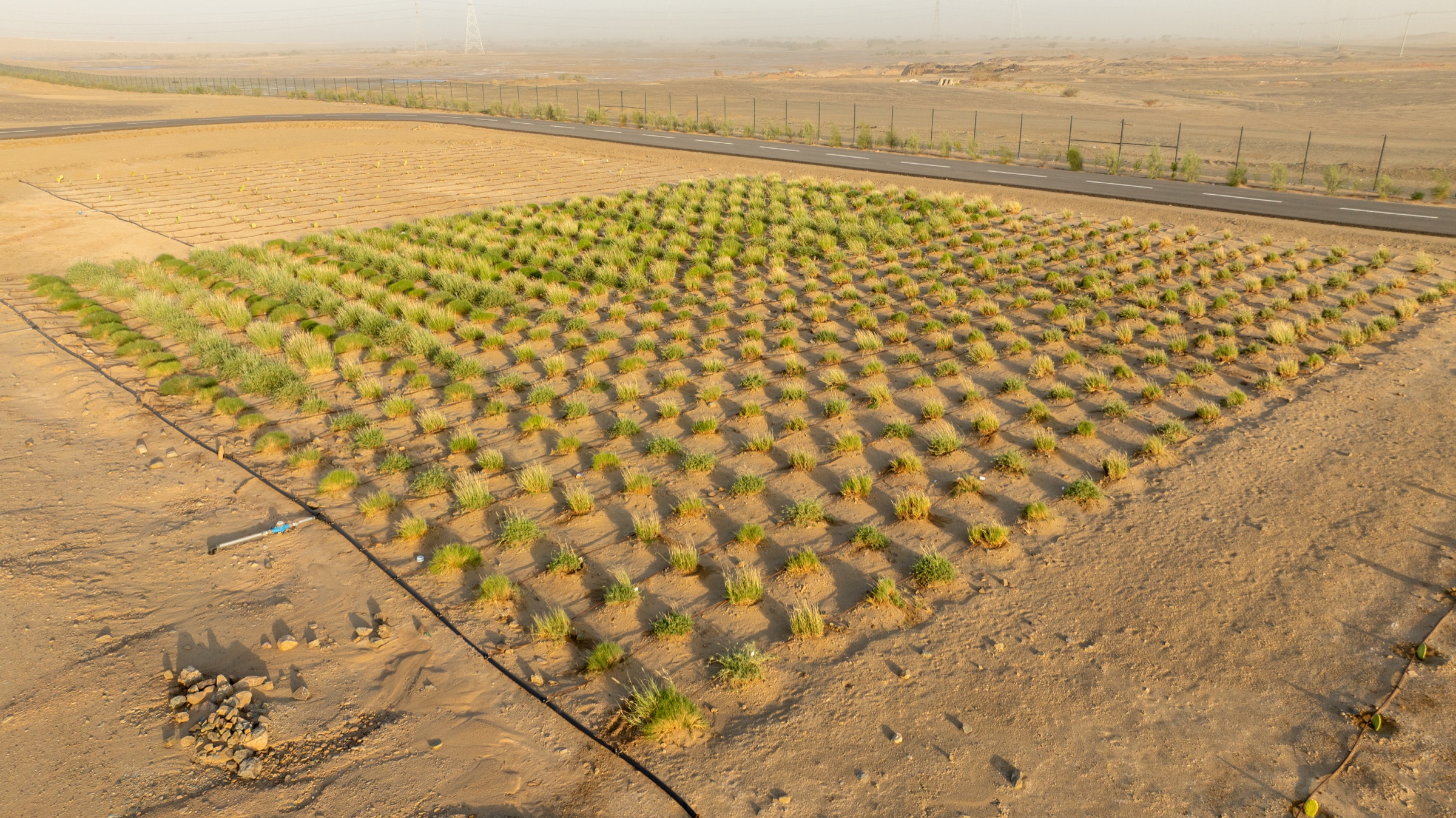
Why organics matter.
A national challenge. A clear ambition. Local action that counts. Edama connects organic-waste recovery with useful compost, community participation and evidence for ESG reporting.
Explore Saudi Vision 2030 ↗The scale of the issue
45.7% of Saudi Arabia's recorded waste is organic.
61.7 million tonnes in 2024, across economic activities and households.
National ambition
90% of waste diverted from landfill by 2040.
Two national ambitions with different scopes. Organic resource recovery can contribute to both.
Our contribution at KAUST
15,000+ tonnes of organics recycled instead of landfilled.
≈ 6,200 tonnes CO₂e avoided.
Turning community organics into resources for greener landscapes.
Sources & estimate calculation ↗The KAUST resultsESG in practice. Resource recovery. Community participation. Traceable reporting.
Our ESG approachSources & how we calculate impact
National context. GASTAT's 2024 waste statistics report 61.7 million tonnes of organic material, 45.7% of all recorded waste. The MWAN strategic plan sets a 90% landfill-diversion target for 2040. Saudi Vision 2030's Story of Transformation states the Kingdom's ambition to achieve net-zero carbon emissions by 2060. These are national targets, not Edama results. Not all organic waste is suitable or available for composting.
KAUST recovery. Reconciled operating records show more than 15,000 tonnes recovered for composting from May 2022 to June 2026, after estimated contamination deductions. This is the recovery measure used here to describe diversion from landfill; it is not finished-compost output or a campus-wide diversion rate.
Indicative estimate of approximately 6,200 tonnes CO₂e avoided compared with landfill, May 2022 to June 2026. Based on more than 15,000 tonnes of organics recovered and the historical EPA WARM v14 comparison: a difference of 0.36 tonnes CO₂e per US short ton between landfill and composting. This US model is not measured site emissions or a carbon credit. Soil-carbon storage is included once. EPA WARM v14, February 2016, Exhibit 2-4
01 · Saudi Vision 2030
Climate action.
ESG in practice.
Turn national priorities into a programme for your organisation: recover suitable organic waste, return value to soil and document the result.

Environmental
Less landfill. More useful resources.
Landfill diversion
Source separation and composting give suitable food and green waste a recovery route. The material recovered contributes to the national landfill-diversion ambition shown above.
Climate action
Compare recovery with a defined landfill baseline, including transport and processing emissions. This can support an organisation’s climate plan; estimated avoided emissions are reported separately from measured recovery.
Circular soil products
Return organic matter to agricultural and landscape soils through compost selected for the soil, crop and intended use.
Social
Participation that reaches the soil.
Staff and community participation
Clear bin signage, sorting guidance and awareness activities help people separate organics where they work and live. Participation and contamination can be reviewed to improve the programme.
Greening and restoration
Suitable compost can support planting, parks and soil-restoration projects. This connects practical community activity with the Saudi Green Initiative’s long-term ambition to plant 10 billion trees.
Prevention first
Food-waste measurement can help identify prevention opportunities. Recovering unavoidable residues complements prevention; composting alone does not count as halving food loss and waste.
Governance
Evidence behind every reported result.
Traceability
Agree records for material received, contamination, recovery and destination. Assign responsibilities across the collection and treatment process.
ESG reporting
Define indicators, reporting periods and supporting evidence with your sustainability team. Separate measured quantities, estimates and future targets so disclosures can be reviewed.
Clear boundaries
Confirm material acceptance, service scope and reporting requirements before starting. Records support oversight; they do not automatically confer regulatory compliance, an ESG rating or carbon credits.
Explore the climate calculationBaseline, processing and soil carbon
The size of the benefit depends on what would otherwise happen to the waste, landfill gas capture, transport, processing and how the compost is used. Composting itself has emissions. A credible greenhouse-gas reduction estimate compares those activities on a defined basis, with its assumptions visible.
How waste-management emissions are compared · US EPA (PDF) ↗Explore the national policy contextMWAN, food security and water security
Where waste, food and water policy meet
MWAN
National Center for Waste Management
MWAN's direction is to move more material away from landfill through an organised waste-management system. For suitable organics, the practical work starts with separation, appropriate treatment and a useful destination for the recovered material.
Explore MWAN's role ↗MEWA & food security
Ministry of Environment, Water and Agriculture
Saudi Arabia aims to reduce food loss and waste by 50% by 2030. Preventing edible food from being lost protects the food itself and the water, land and other resources used to produce it. Through the General Food Security Authority and its Letadom programme, measurement and prevention are part of this effort.
The national food-loss-and-waste indicator was 27.9% in 2024, announced in 2025, down from an earlier 33.1% baseline. This measures food loss and waste, not the organic share of all recorded waste.
GFSA results · Saudi Press Agency ↗Measurement year · NTP 2025 report (PDF) ↗Recycling comes after prevention: suitable unavoidable residues can return value to productive soil. That connects food-waste management with the conditions needed for agriculture, while keeping edible food in use remains the first priority.
MEWA · The 2030 food-loss-and-waste objective ↗MEWA & water security
National Water Strategy 2030
In an arid country, reliable food production must be considered alongside limited water resources. MEWA's National Water Strategy prioritises demand management, efficient use and protection of water resources. Better soil management belongs alongside appropriate crops and efficient irrigation in that conversation.
MEWA · National Water Strategy ↗02 · The problem
The hidden impact
of buried organic waste.
When food and other biodegradable material are buried, oxygen becomes scarce. Microorganisms continue breaking them down, producing methane: a powerful greenhouse gas. This is why organic waste has a climate impact long after the collection truck leaves.
Explore the landfill evidenceMethane, international context and leachate
Food scraps and garden cuttings are different from glass or metal. Their ability to decompose gives them a particular role in landfill emissions. A landfill's gas collection system can capture some methane, but escaping emissions remain an important part of the problem.
Explore the science of organic decomposition · US EPA ↗There is also a water-pollution issue. Liquid moving through waste can collect dissolved substances and become leachate. Landfills need systems to collect and manage this contaminated liquid. Recycling suitable organic material changes its destination while preserving resources that would otherwise be buried.
Read about landfill leachate · US EPA ↗03 · A different journey
The change begins
at the bin.
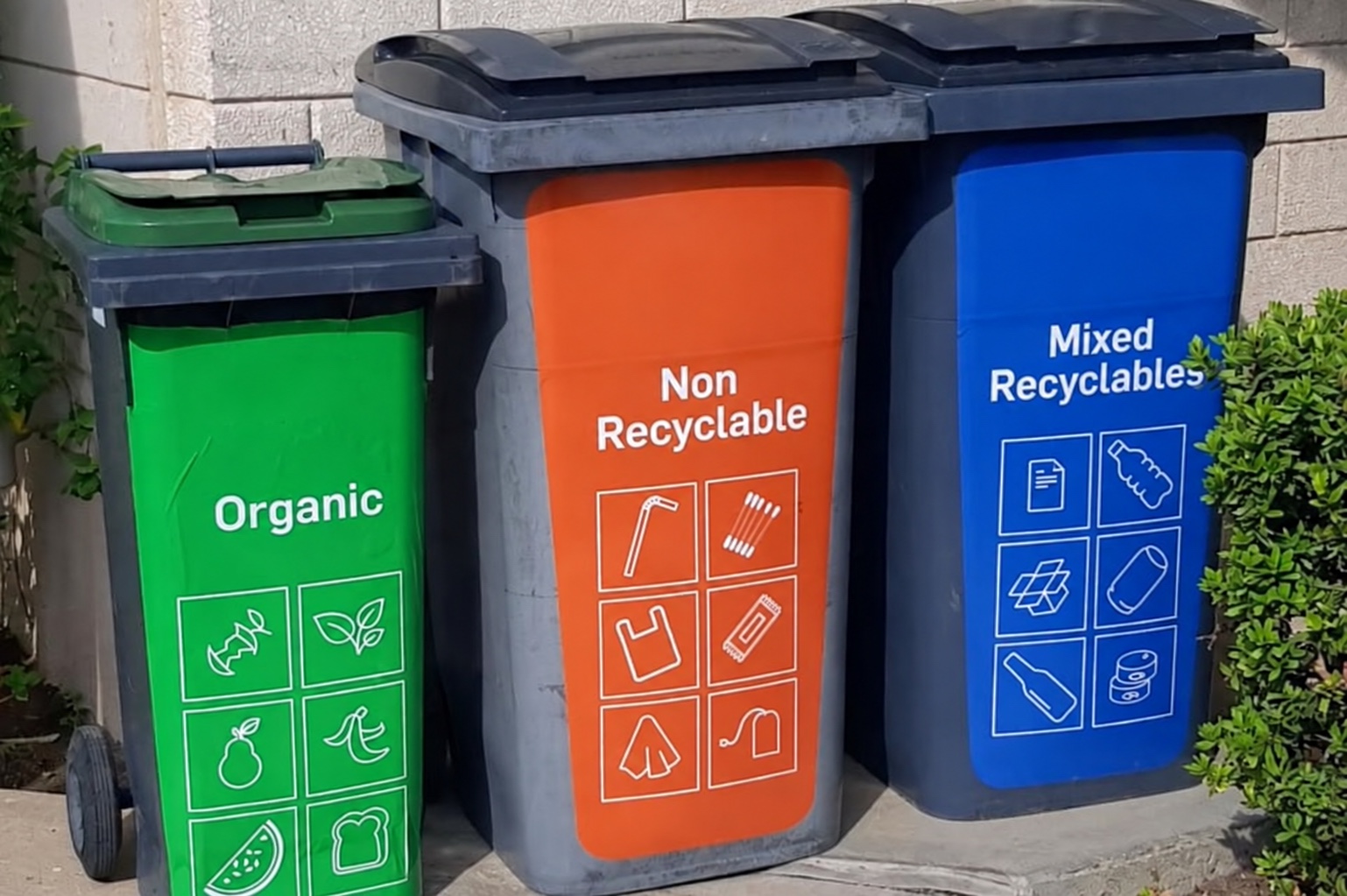
The best starting point is to prevent avoidable waste and keep edible food in use for people. For suitable organic material that remains, source separation opens a different route. Keeping plastics, glass and other contaminants out helps protect the quality of the material we hope to return to the soil.
Why prevention comes first · US EPA Wasted Food Scale ↗Composting works with biology. A managed balance of air, moisture, materials and time allows microorganisms to transform organic waste into mature compost. Sorting, process control, maturation and quality checks turn an everyday discard into a useful soil input.
How composting works · US EPA ↗- 01

Separate
Keep suitable organic material apart from general waste.
- 02

Transform
Manage the composting process, then allow the material to mature.
- 03

Return
Check compost quality and match it to the soil and intended use.
This is the connection at the heart of Edama's work: organic waste recycling linked to premium agricultural products for desert agriculture and green initiatives. Each service starts with an assessment of the material and operating requirements.
04 · The value inside
Waste still holds
the ingredients of growth.
Compost brings two kinds of value back to soil: nutrients that plants use, and organic matter that helps the soil function.
Nutrients to cycle again
Compost contains nutrients including nitrogen, phosphorus and potassium. Their amounts and availability vary with the feedstock and process. Release can be gradual, so compost use belongs within a crop's wider nutrition plan.
More than plant nutrition
Organic matter supports soil structure, water retention and soil organisms. Its value reaches beyond a fertiliser analysis: it helps create the conditions in which roots, water, air and living organisms interact.
Explore the soil scienceWater, nutrients, soil structure and application boundaries
Why sandy soil needs more than water
Many arid soils contain little organic matter. In sandy soils, relatively large grains leave large spaces between them. Water can enter readily, then drain under gravity beyond the root zone. Compared with finer soils, sand also has less surface area on which water and certain nutrients can be held.
That means a field can receive irrigation and fertiliser while still struggling to keep those resources available to roots. The challenge is not simply supplying more; it is understanding what the soil can retain and matching applications to the crop.
Arid-soil conditions · FAO ↗Soil particles, pores and water · Penn State Extension ↗
Water needs places to stay
Organic matter can improve the pore system and water-holding capacity of sandy soil. More moisture can remain after rapid drainage, although not all retained water is available to plants. Roots still need air, and drainage still matters.
Nutrients need holding sites
Organic matter adds negatively charged surfaces that can hold positively charged nutrients such as potassium, calcium and magnesium. This ability is called cation exchange capacity. Nitrate behaves differently and can still move with water.
Soil needs a living structure
Compost supplies organic matter that supports soil organisms and helps particles form stable aggregates. It changes how the soil functions over time; it does not turn sand into clay or replace a complete crop-nutrition plan.
A closer look at the spaces between grains
The sand stays sand.
The way it holds resources can change.
Little organic matter
Water moves down quickly
Large pores drain readily. Sand offers relatively little surface area to retain moisture and nutrient ions.
With suitable mature compost
Drainage continues
Added organic matter can create more water-holding spaces and sites that retain positively charged nutrients.
- Sand grain
- Organic matter · negative charge
- Water
- Nutrient ion · positive charge
Organic matter in sandy soils · FAO ↗
The right compost.
The right application.
In dry climates, soluble salts deserve particular attention. Test the soil, irrigation water and compost; check maturity, electrical conductivity (a measure related to salinity), nutrients and the crop's tolerance. Match the application rate to these results.
Compost does not remove the need for water or guarantee a particular yield. Edama's Premium Green Compost is intended for blending with existing soil; its uses and evidence are explained on the Products page. Returning suitable local resources to farms and landscapes makes the connection between waste management and productive land tangible.
Understanding compost quality and salinity · Oregon State Extension ↗The programme in practice
See the work at KAUST.
Explore the facility, community participation and how compost returns to campus landscapes.
Explore the KAUST project ↗Grow Plants, Not Landfills.
Give organic resources
a useful next chapter.
From the way a kitchen separates food scraps to the way a landscape team cares for its soil, the cycle depends on people making it work. Edama connects recycling services, product development and practical operating experience to help build that cycle.
Inquire about recycling servicesThe science links explain composting and soil processes in general. Edama's product and project results are presented with their own evidence on the relevant pages. Saudi figures retain their reference years; national objectives are targets, not Edama results or endorsements. Sources reviewed September 2026.